
Choose the AI model an agent uses
Pick the AI model behind an agent, read what the model list means, see how managed and own-key usage is billed, and check its runtime and health.
On this page
The model is the AI that does the thinking for an agent: it reads each message, decides what to do and writes the reply. You pick one when you create the agent, and you can change it at any time from the agent's settings. A stronger model handles harder work; a lighter one keeps usage down.
Change the model#
- In the sidebar, click Agents and open the agent.
- Click the Settings tab. It opens on General.
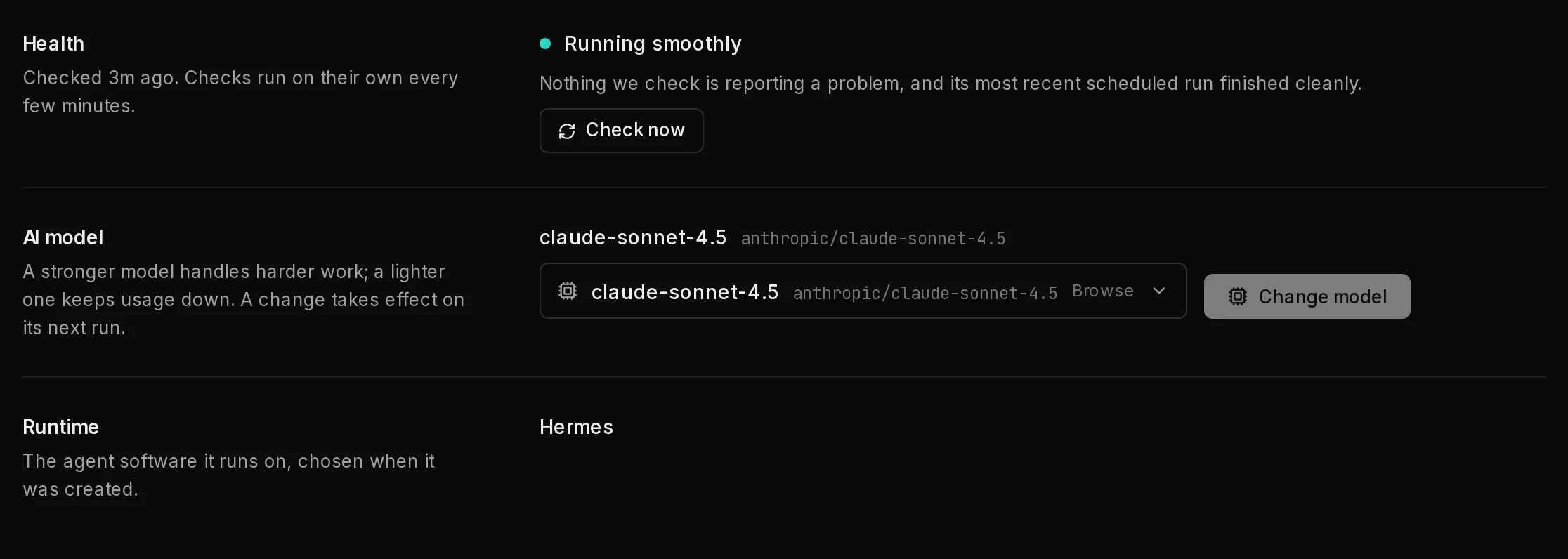
- Under AI model, click the model field (1). The Choose a model dialog opens.
 1
1In the dialog:
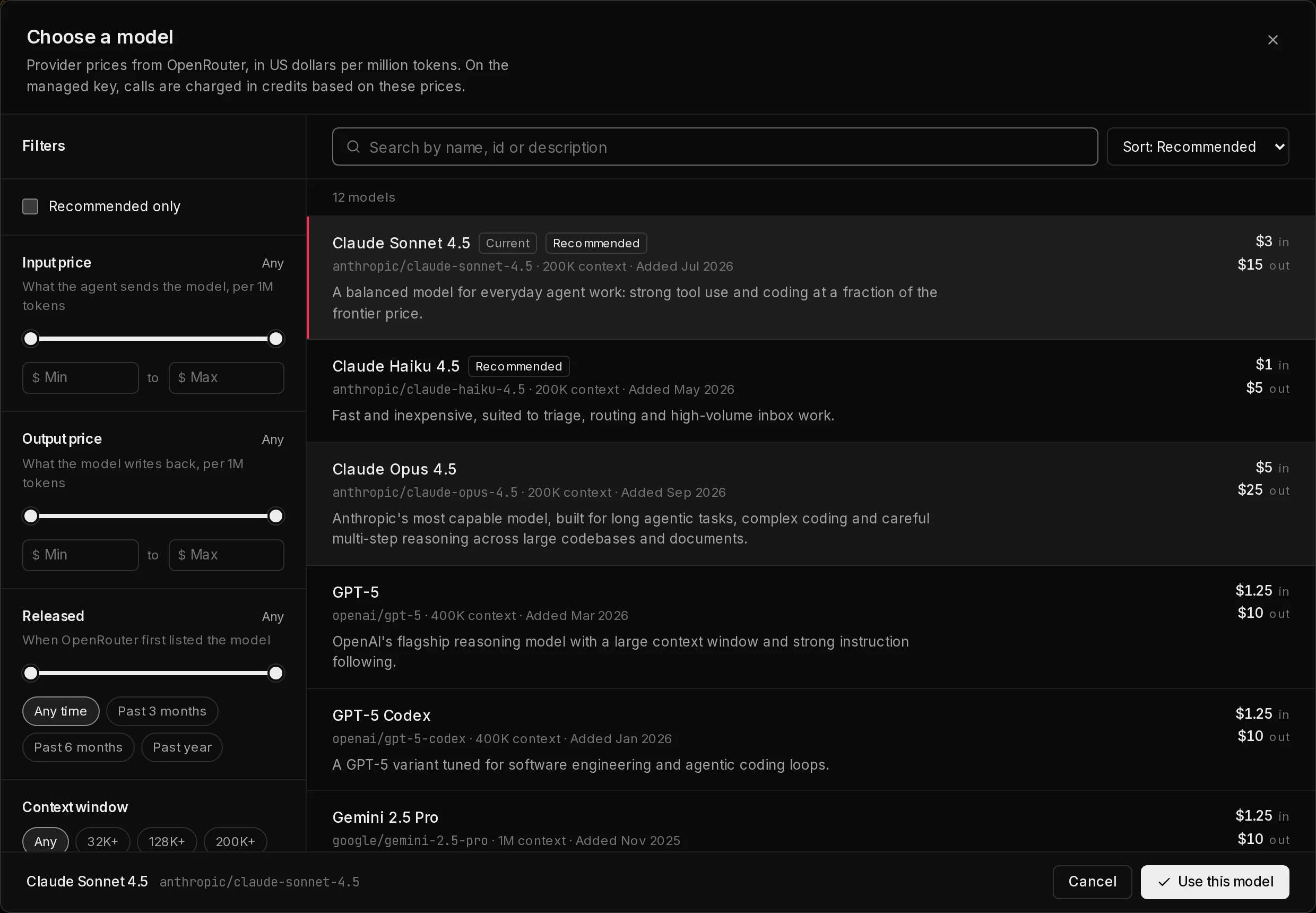
- Narrow the list with the filters on the left (1), search by name, ID or description (2), or reorder it with the sort menu (3).
- Click a model to select it, then click Use this model (4). Double-clicking a model does the same.
 1234
1234Back in Settings, the field shows the model you chose. Click Change model to apply it.
While the change is applied you see "Switching *agent* to *model*…". When it finishes, the row says Saved and the agent uses the new model from its next run. To pick again, click Change again.
What the model list shows#
Each model shows its name, its ID in the form provider/model (such as anthropic/claude-sonnet-4-6, where the part before the slash is the company that makes the model), a short description, how much text it can read at once (its context window), and when it was added to the catalog. On the right are its input and output prices.
- Prices are the provider's list prices from OpenRouter, in US dollars per million tokens. Input is what the agent sends the model; output is what the model writes back. On the managed key, calls are charged in credits based on these prices; on your own key, your provider bills you directly.
- Recommended: models Qoren has marked as a good fit carry a Recommended tag and sort to the top by default. Turn on Recommended only to see just those. They are a suggestion, not a limit: every model in the list is available on every plan.
- Sorting: by name, price (cheapest or priciest first, by input plus output), largest context window or newest.
Filter the list#
The sidebar narrows the list as you change it. On a phone, open it with Filters; the number on the button counts the filters in use.
- Input price and Output price: drag the two handles of each slider to set the lowest and highest price you want, or type exact dollar figures into the boxes under it. The slider spends most of its length on the cheaper end, where most models are. A handle at the far right means no upper limit.
- Released: drag the handles to a range of months, or pick Past 3 months, Past 6 months or Past year.
- Context window: show only models that can read at least 32K, 128K, 200K, 400K or 1M tokens at once.
- Provider: tick one or more companies. The number beside each is how many of its models are listed.
Reset at the top of the sidebar clears the filters and keeps your search. Clear search and filters above the list clears both. A model with no listed price or release date, such as an ID your team saved itself, is hidden while a price or date range is set.
- The current model is always listed and tagged Current, even if it has since left the catalog, so you never lose it by opening the picker.
- The list is the same for every runtime. Hermes, OpenClaw and Codex agents choose from the same catalog.
There is no box for typing a model ID by hand here: you pick from the list.
How to choose#
- Start with a recommended model and change only if the agent struggles or costs more than you want.
- Pick a stronger model for agents that plan several steps, write long documents or work with code.
- Pick a lighter model for agents that sort, summarize or reply to routine messages all day.
- After a change, watch the agent's Usage tab for a few days to see what the switch did to its spend.
Managed key or your own key#
Every model call is paid for in one of two ways, set for your whole account rather than per agent:
- Managed key (the default). Qoren provides the model key and charges the agent's model calls in credits from your balance. See how credits work for what a call costs.
- Your own key. If you connect your own OpenRouter key under Settings, BYOK, model calls go to your key and the provider bills you directly. Qoren does not charge credits for those calls. Web search and mailboxes are still charged in credits either way. Setup is in bring your own key.
Switching between the two does not change which model an agent uses. It only changes who pays for the calls.
The Runtime row#
Runtime shows the agent software the agent runs on: Hermes, OpenClaw or Codex. It is chosen when the agent is created and cannot be changed from this page. The runtime decides some features, such as whether the agent can import skills. Runtimes compares them.
The Health row#
Health at the top of General is a one-line answer to "is this agent all right?". Checks run on their own every few minutes, and the row says when the last one ran. If the agent is running, you can click Check now to run one straight away.
| Status | What it means |
|---|---|
| Running smoothly | Nothing checked is reporting a problem. |
| Needs a look or Gone quiet | It is up, but something about its recent work needs attention. |
| Part of it has stopped or Can't be reached | It is not working right now. A repair usually brings it back. |
| Something went wrong | It did not finish setting up. |
| Still setting up | Health checks start once it is running. |
| Paused | This month's usage budget is used up. It carries on when the budget resets or you raise it. |
| Not checked yet | It is running, but its first check has not been recorded. |
When the status is red, repair the agent. When it says Paused, see spend controls.
Frequently asked questions#
Does changing the model restart the agent or lose its memory?
No. Qoren rewrites the model setting in the agent's configuration and the agent picks it up on its next run. Its identity, instructions, files and conversations stay as they are.
Can two agents use different models?
Yes. The model is set per agent. Only the choice between the managed key and your own key applies to the whole account.
Why is the model list missing?
The agent has not finished setting up yet. The picker appears once it is active, or if setup failed.
Do recommended models cost less?
Not necessarily. Recommended means Qoren suggests it as a good fit. What a model costs depends on the model itself; the agent's Usage tab shows what it actually spent.